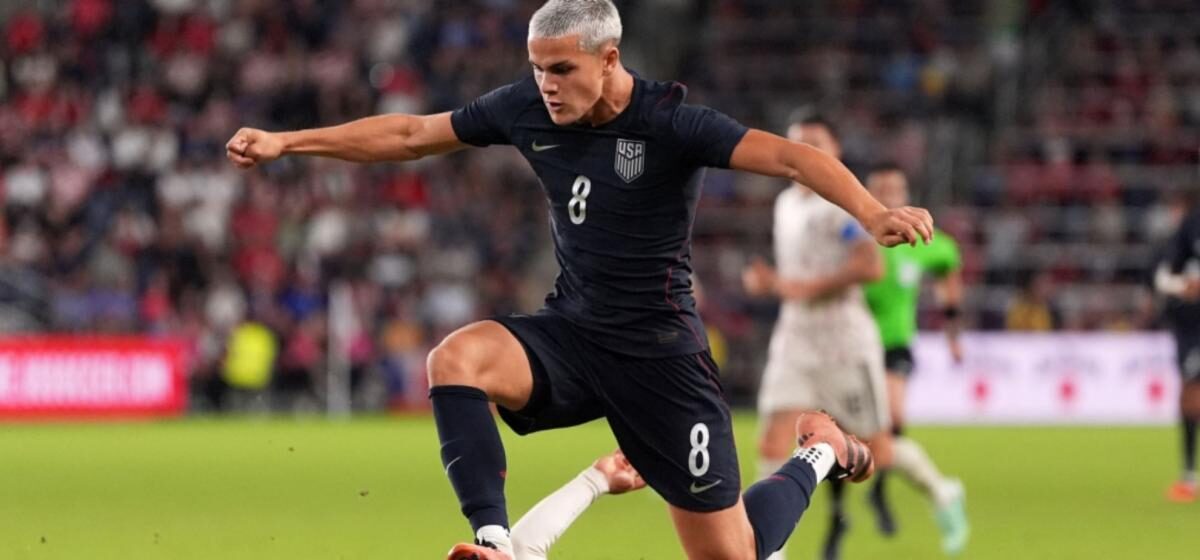
Mauricio Pochettino has begun assembling the United States team he hopes will carry the country to the 2030 World Cup, using the September international window to hand out debuts on a scale rarely seen in the national team’s history. As many as 12 players made their first appearance for the Stars and Stripes during the FIFA window, and the average age of the squad called up did not exceed 23.
The overhaul follows a 2026 World Cup in which the hosts topped their group, came through a knockout round for the first time since Korea and Japan 2002 and scored 11 goals — their highest tally in a single edition of the tournament — before falling in the round of 16 against Belgium, a campaign that also included the Balogun scandal. Pochettino was candid about how it ended. “It wasn’t the way we wanted to finish, but it’s something we can learn from going forward,” he said. “In one year, this team showed that it can play football and compete. We still need to keep improving. But there are many players with potential and a generation of youngsters coming through behind them. It’s about continuing to believe.”
His first squad since the tournament was notable for its absences: Balogun, Pulisic, McKennie, Johnny Cardoso, Tim Weah and Tessman were all missing. With no official competition matches on the calendar for the window, Pochettino treated the break as the ideal moment to start integrating members of the crop the country has been producing.
The coach framed the shift as a deliberate change of approach, pointing to the example of Lamine Yamal and Spain. “It is a completely different approach from the past. The World Cup is in four years. We need to work with different objectives and goals,” he explained. “If you look at Lamine Yamal, Spain won the World Cup with an 18-year-old boy. You think: ‘No, he’s too young. He needs more experience.’ Why? He’s the best.” He added: “If we have players of the same age — 16, 17, 18, 19 — and they are good… Then why not? It’s about giving them the opportunity and having them take advantage of it. That is the mentality we want to build in this process.”
The leading figure of the new generation is Cavan Sullivan, born in Philadelphia in 2009, who already has an agreement to join Manchester City when he comes of age. At just 14 he surpassed Freddy Adu as the youngest debutant in MLS history, and two years on, now established in the ranks of Philadelphia Union, he has earned his first senior United States call-up after being involved in 12 goals since the competition resumed following the World Cup.
“He deserves all the praise he is receiving. He is performing well, providing assists and scoring goals at 16 years old,” Pochettino said of Sullivan. “The important thing is to be with him and try to provide him with a solid platform to lean on. He still needs to show more, improve, evolve and mature.”
Sullivan is not the only prospect to have emerged during the break. Against Chile, Mathis Albert — born in Greenville in 2009 — surpassed Pulisic as the youngest debutant in the history of the national team, just a few months after becoming the third-youngest player at Borussia Dortmund. Julian Hall, born in New York in 2008, has found the net in the friendlies played so far by the team of “the stars and stripes”.
Alongside them, the window brought debuts for Justin Ellis (Orlando City, 2007), Brooklyn Raines (New England, 2005), Adri Mehmeti (RB New York, 2009), Zavier Gozo (Crystal Palace, 2007), Frankie Westfield (Philadelphia Union, 2005), Neil Pierre (Philadelphia Union, 2007), Peyton Miller (New England, 2007), Diego Kochen (Lyngby BK, 2006) and Brian Schwake (Nashville, 2001).
Pochettino, however, is calling for calm around a group he believes must be protected as much as promoted. “You have to be careful because, when you are young, you need self-confidence… but there is a limit. Balance is the most important thing and one of our responsibilities is to protect these boys because, sometimes, if you play well, you are 16, 17 or 18 years old and people start talking as if you were Messi… if you get confused and do not manage it well, it can be dangerous,” he warned. Excitement around his “Team USA 2030” is, nonetheless, through the roof.