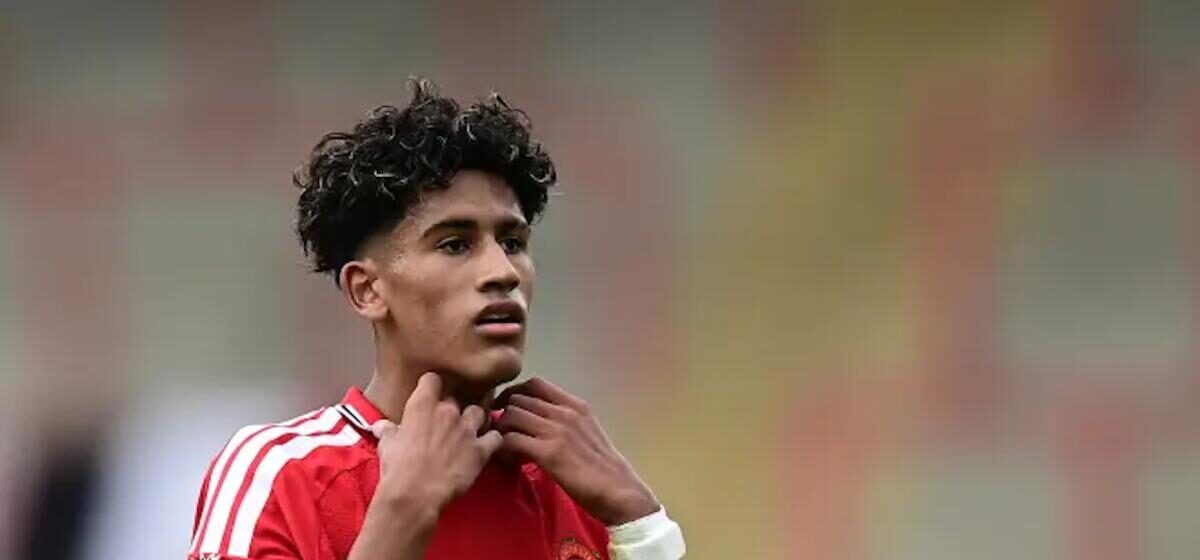
JJ Gabriel turns 16 on Tuesday, and with the birthday comes the key that finally unlocks his future. Until now his age alone had prevented him from signing a contract, which is why the most sought-after teenager in European football reaches the milestone with Real Madrid and Barcelona among the clubs vying for a signature he could not previously put down on paper.
The youngster worth putting a face to is Joseph Junior Andreou O’Cearuill, born in Enfield, London on 6 October 2010. He is a two-footed forward with a preference for his right foot, shaped in futsal before he ever played on grass — the origin, those around him say, of his command of spaces where there is not room for a pin. He came through the youth academies of Chelsea, Arsenal and West Ham before ending up at Manchester United, where his arrival was sealed on a date he wanted to celebrate himself: on 4 August 2022, at just 11 years old, he posted on Instagram that he was delighted to have finally had his “signing day”, and even more so to share it with his teammate Cristiano Ronaldo Jr.
At Old Trafford he has since smashed precocity records. He made his debut for United’s Under-18s in April 2025 at the age of 14, scoring a brace in a rout of Leeds and becoming the youngest player ever to wear that shirt in the club’s history. He ended the following campaign with 26 goals in 29 youth matches, won the Jimmy Murphy award as United’s best young player — its youngest-ever winner, ahead of Ryan Giggs — and was named the Premier League’s best Under-18 player. This season his Youth League debut ended with a hat-trick against Sabah. Rubén Amorim called him up to train with the first team, and Michael Carrick gave him his first minutes in a preseason friendly. At Carrington they consider him, without qualification, the best player born in 2010 in the whole country.
The origin of his fame, though, did not spring from a stadium but from a screen. At the age of eight, a video looped across the internet and christened him forever: almost five million people watched a clip in which a YouTube channel introduced him as “Kid Messi”. That nickname has pursued him ever since like a shadow that neither he nor his family want anything to do with.
The brand machinery started early too. He signed with Nike as a little kid, in a deal the British press described as the most lucrative ever awarded to a 14-year-old boy, even surpassing the one Santos gave a teenage Neymar. His name went through a similar operating room: born O’Cearuill, he competes as “Gabriel”. According to The Athletic, his father adopted that surname in recognition of the family’s religious beliefs and because his own had already come to mean little to him, while in the British press there is also the unofficial reading that “O’Cearuill Jr” did not sound enough like a star. From the same logic came another detail: United granted him the number 95 shirt, the highest number the club has ever assigned, and this season he is already playing with 77. On Instagram, where there is no trace whatsoever of any link to the Manchester club, he has more than 850,000 followers — an unusual figure for someone who has yet to make his professional debut.
An England youth international at Under-15, Under-16 and Under-17 level, he is also a passport puzzle. He can play for Ireland through his paternal grandmother, for Cyprus through his mother’s side, and even for Trinidad and Tobago. That tangle of nationalities is far from a mere anecdote: it is what could decide his future.
The saga, long brewing, exploded over a few weeks in September. The prelude had come in July when, according to the BBC, he did not report for the start of the academy’s preseason; even so, on 1 August he played with the first team against Atlético de Madrid. On 8 September he was still posing in the squad’s official photo and, two days later, he dazzled in his European debut in the Youth League, with sporting director Jason Wilcox following him from the stands. By then one complication was already weighing on matters: because of his age he did not fit into either of the two lists with which the club registers its squad for the Champions League, so his goals kept coming with the youth teams rather than the seniors. On the 15th came the showdown — he refused to train and sent a formal notice terminating his contract “with immediate effect”, to which United replied that the player “cannot be deregistered”. The following day Carrick, who had planned to call him up, had to play without him and lost 3-2 to Brighton in the Carabao Cup. With that refusal vanished the chance of Gabriel taking a record that has stood for almost seventy years: David Gaskell’s first-team debut at 16 years and 19 days old in the 1956 Charity Shield. As of today he is still registered with the English federation as a United player, even though he has stopped setting foot in Carrington. It is not the first time his future has been up in the air: as recently as last summer he was on the verge of leaving, until an emergency meeting convinced him to stay.
This time the outcome appears to be heading in a different direction, and with top-level backers. Real Madrid, Barcelona, Bayern Munich and PSG have joined the queue, a quartet of giants also joined by City and Chelsea.
Two figures are central to the story, and they are often confused. On one side is the father, Joe O’Cearuill, a former footballer with two caps for Ireland who played for Arsenal, Brighton, Barnet, Forest Green and St Patrick’s, and who has acted as his son’s guide, mentor and personal coach since childhood. He is the family face, the one who looks after the boy and who has made the major decisions in his life, including the change of surname. On the other is the professional agent Ali Barat, founder of the Epic Sports agency and a two-time Golden Boy winner for best representative, who is expected to formally take over the youngster’s career starting this Tuesday. Barat is no stranger to Madridismo: his stable orchestrated this very summer Dumfries’ arrival at the Bernabéu. He is leading the operation and handling the bulk of talks with clubs, although the father retains weight and a voice at the negotiating table — no major decision is made without his approval.
Here lies the crux that explains why the explosion comes right now. Upon turning 16, Gabriel crosses the threshold that allows him to sign his first apprentice contract and decide his future; that is the key that triggered the soap opera, not a day earlier. A move to Spain, however, is not as simple as blowing out the candles. FIFA rules generally prohibit international transfers of minors under 18, and the exception allowing transfers within the European Union for those over 16 stopped covering English clubs after Brexit. That is where the passport puzzle reappears: the Irish one, as an EU passport, is the route his entourage is invoking to qualify for that exception and open the door to the continent — a convoluted path, subject to FIFA’s scrutiny, which views any deal involving a minor with suspicion. United, moreover, has no intention of making things easy. If Gabriel moves abroad the club would receive barely around £300,000 in training compensation, a pittance for a player predicted to be worth one hundred million someday, and it is considering legal action against whoever it believes has been manoeuvring behind its back. Meanwhile the youngster has been training alone for weeks with a personal coach, specifically near Castelldefels. Real Madrid, for its part, wants to toughen him up in Castilla and is closely following his every move.
What no one disputes, on one side or the other, is the talent. At Old Trafford they lavished him with praise. Darren Fletcher, who coached him at Under-18 level and served as interim first-team manager, portrayed him more through his character than his left foot: “JJ is a fantastic talent. The first thing I would say is that he loves football. He loves training, he loves playing, he loves having the ball, he loves expressing himself.” Adam Lawrence, in charge of the club’s professional development phase, summed up his task with revealing humility: “The first thing is that my job is not to ruin him,” adding a week before everything blew up that “JJ is surrounded by people who truly believe in him, from the very top of the club to the bottom.” Bryan Mbeumo, who measured himself against him in first-team training, was surprised by his build: “He’s strong, the little one is strong. You think he’ll be a little kid, but you notice he has something special.” Carrick called him “a really great talent”, though after the split he urged caution and put the child before the player: “He is a 15-year-old boy. It’s more about JJ’s wellbeing, care and attention as a child.” Wayne Rooney, father of his teammate Kai, said he has “seen him develop, and he’s a fantastic player”, and on his podcast Stick to United said the club “has done everything” to keep him and that “everyone close to it probably knew this was coming.” Even Ryan Giggs was won over, calling him “a kind of generational talent”, albeit with one plea: “He has to stay at Manchester United.”
It is also worth hearing a voice that tempers the euphoria. Nathan Salt, a Daily Mail journalist who specialises in Manchester United and the lower tiers of British football, brings a dose of realism. “If we strip away the noise around ‘Kid Messi’, I think he has the technical ability to play for Real Madrid or Barça,” he says, before delving into the contradiction of a jewel with no obvious place to shine immediately: “It’s a real family gamble, but it feels like they’ve been planning the move to Spain for years.” Salt also notes the change in mood at Old Trafford: “He was seen as their next superstar, but now the belief inside the club is that Gabriel is not going to play. United is coming to terms with what his departure would mean.”
There remains, in the end, the question no signing can answer in time: what will become of this phenomenon in three or four years. Football is full of “new Messis” who remained just promises, of viral children who could not bear the weight of their own label. JJ Gabriel turns 16 today with Europe’s giants at his feet and a crossroads in deciding his next step.